Michigan roboticists will join researchers from around the world in Pittsburgh, Pennsylvania for the 2026 IEEE/RSJ International Conference on Intelligent Robots and Systems (IROS) from September 27 through October 1. IROS is one of the largest robotics research conferences, serving as an annual forum for researchers to explore the frontiers of intelligent robots and smart machines.
University of Michigan researchers are making the trip to share their latest work. Check out the workshops and papers below.
And, the conference is as much of an opportunity to meet other robiticists as it is to explore Pittsburgh. To help attendees get the most out of their trip, we’ve gathered tips for visiting the city from a former Pittsburgh resident: Alyssa “Emigh” Hudak, adjunct lecturer and Robotics Makerspace supervisor. Hudak works behind the scenes of many robotics labs, courses, and teams to fabricate parts and train students, as well as teaches storytelling with robotics. Find Hudak’s Pittsburgh tips throughout this article.
Workshops through the week
Social Robot Navigation and Multi-Robot Systems talks
Christoforos Mavrogiannis, assistant professor of robotics, delivers a talk at the 5th Workshop on Social Robot Navigation: From Humans, to Robots, and to the World, and a second at the Tightly Coupled Physical Interaction and Collaboration in Multi-Robot Systems workshop, speaking on site preparation with multi-robot teams.
Uncertainty, foundation models, and semantic mapping
Bernadette Bucher, assistant professor of robotics, gives two workshop talks. At Rethinking Uncertainty for Modern Robotics Paradigms, she speaks on quantifying and mitigating uncertainty in robotic systems that increasingly rely on large pre-trained AI models. At Semantic-Aware Mapping and Navigation: Towards Cognitive and Adaptive Robots, she speaks on learning interpretable visual representations and estimating their uncertainty for autonomous mobile manipulation.
Tensegrity Robotics: Toward Field-capable, Intelligent Systems
Xiaonan Huang, assistant professor of robotics, co-organizes the sixth in a series of tensegrity robotics workshops held since 2018, bringing together researchers working on the modeling, sensing, and control of robots built from rigid struts and compliant tendons. His co-organizers span Yale, Union College, Rutgers, OTH Regensburg, the University of Houston, Florida International University, and the University of Alabama.
Main conference sessions
U-M researchers join thousands of others to present their accepted papers across perception, planning, legged robots, and more: explore these in-depth below.
State of the Art in Robotic Leg Prostheses: Where We Are and Where We Want to Be
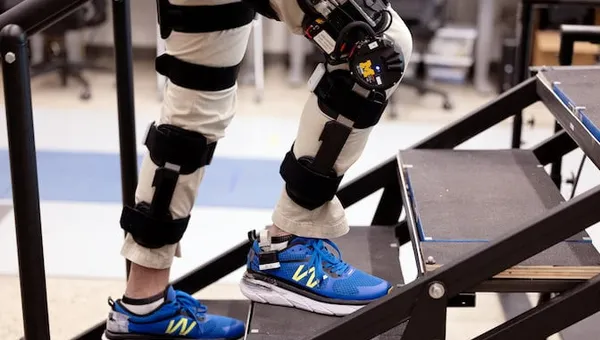
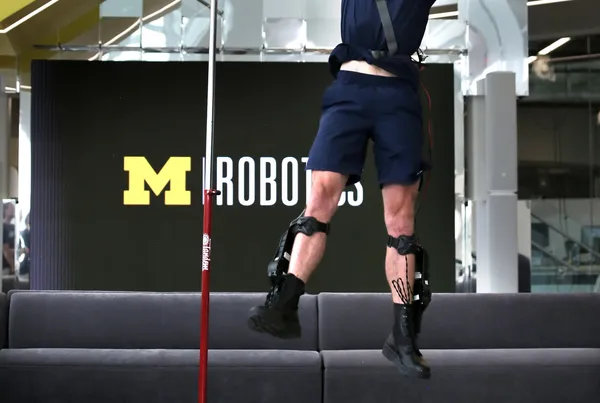
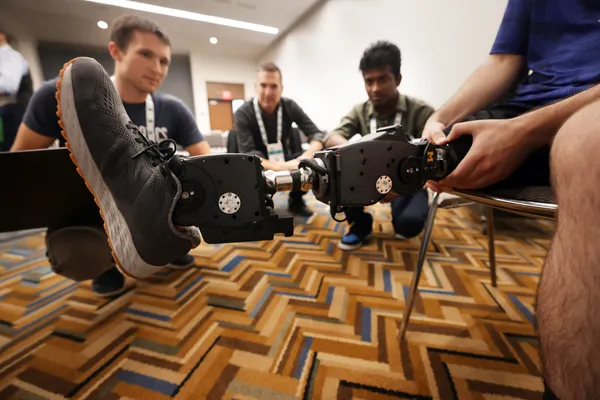
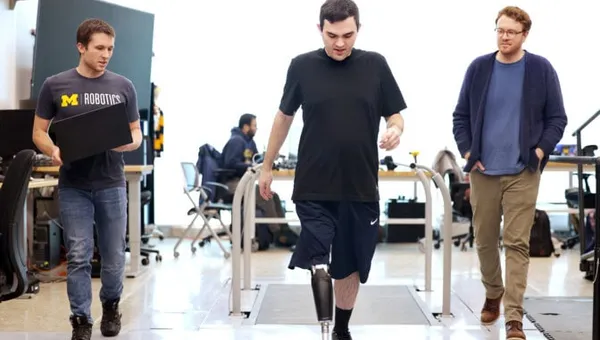
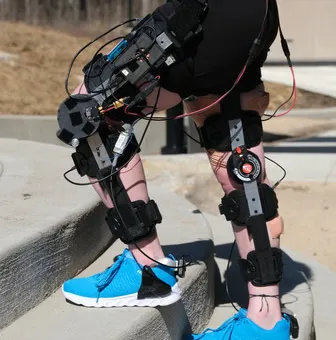
The full-day workshop returns for its third edition, examining advances and remaining challenges in powered prosthetics, from design and control to neural interfaces, along with demonstrations of state-of-the-art devices. Robert Gregg and Elliott Rouse, professors of robotics, are organizing the workshop alongside Ryan Posh of Michigan and The Ohio State University, Tommaso Lenzi of the University of Utah, and Raffaella Carloni of the University of Groningen.
All three Michigan organizers also speak during the day’s sessions: Gregg on his lab’s low impedance leg research, Rouse in a session on design and clinical applications, and Posh in a session on emerging applications.
How can AI integrate into robotics
Bernadette Bucher also speaks at the 3rd AI Meets Autonomy: Vision, Language, and Autonomous Systems workshop, which explores how large language models, vision language models, and foundation models can be integrated into robotic systems for more intelligent and physically grounded autonomy.
Bridging the Gap between Robotic Matter and Active Metamaterials
Steven Ceron, assistant professor of robotics, co-organizes this workshop bringing together researchers in swarm robotics, soft robotics, and metamaterials to explore how computation, actuation, local interactions, and programmable material response give rise to adaptive, self-organizing robotic systems. He is joined by co-organizers from Tsinghua University, Georgia Tech, and EPFL.
Papers and research presentations
U-M researchers are presenting work across a range of focus areas. Below are a selection of papers from Michigan roboticists.
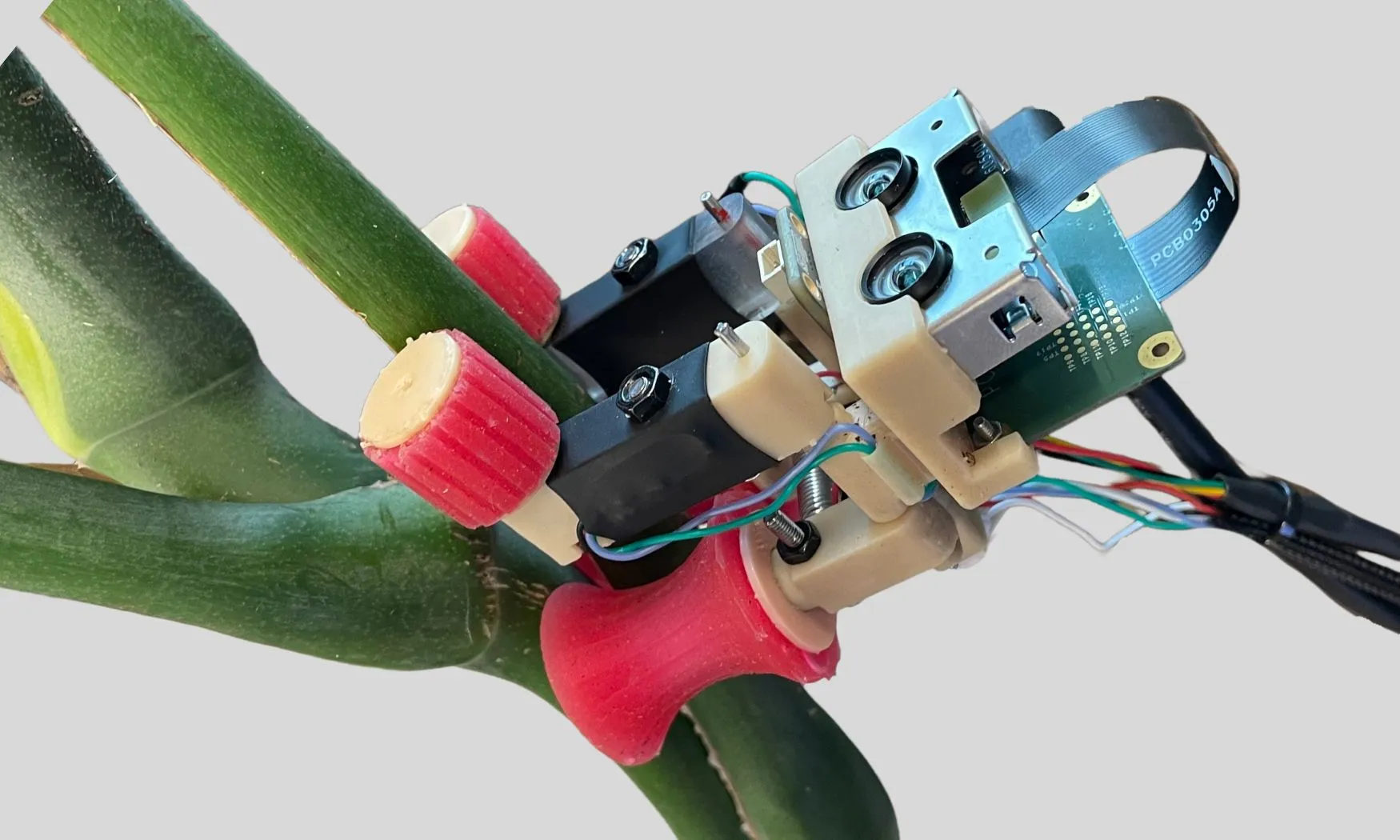
A tiny plant climber patrols under leaves
STEMbot: A Compliant Robot for Under-Canopy Plant Navigation
 Zachary Charlick
 Nilay Roy Choudhury
 Haoyu Ma
 Xiaonan Huang
 Dmitry Berenson
STEMbot is a miniature compliant climbing robot designed to navigate underneath plant canopies, where it can enable early detection of pests before infestations spread. The system integrates a fully geometric PIN-SLAM pipeline with a semantic OcTree to achieve robust localization and mapping while climbing plants, reliably traversing stems from 7 to 33 millimeters across four distinct plant specimens. The work to develop soft microrobots that climb plant stems to rescue crops from pests is funded by the USDA and led by Xiaonan Huang and Dmitry Berenson.
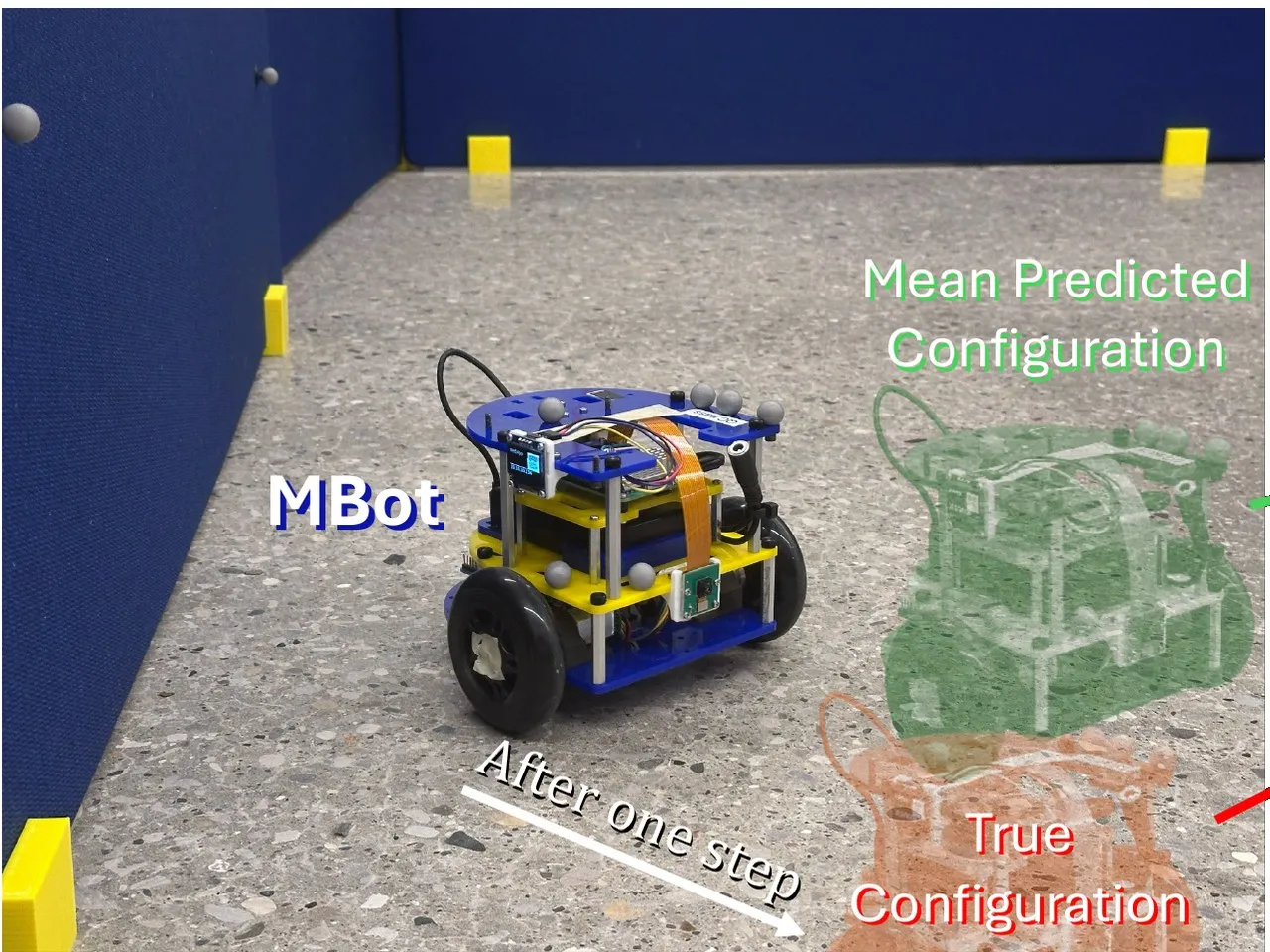
Guarantees a robot can keep when its model lies
Lies We Can Trust: Quantifying Action Uncertainty with Inaccurate Stochastic Dynamics through Conformalized Nonholonomic Lie Groups
 Luís Marques
 Maani GhaffariDmitry Berenson
When a robot’s model of its own dynamics is wrong, how can it still make guarantees about where it will end up? This work, published in IEEE Robotics and Automation Letters, proposes Conformal Lie-group Action Prediction Sets (CLAPS), a symmetry-aware algorithm based on conformal prediction that constructs, for a given action, a set guaranteed to contain the resulting system configuration at a user-defined probability. Experiments on a real MBot show that accounting for the structure of the configuration space leads to more volume-efficient prediction regions.

Evolving better robot legs with springs
SurGE: Surrogate Gradient-guided Evolution for Co-design of Legged Robots with Parallel Elasticity
 Yulun Zhuang
 Yue QinJustin Lu
 Zelin Shen
 Yichen Wang
 Sicheng He
 Yanran Ding
Adding springs to a robot’s legs can make it faster and more efficient. But, designing the body and the controller together is notoriously hard, because contact dynamics and mechanism engagement are non-differentiable. SurGE, from Yanran Ding’s lab, computes surrogate gradients of the design objective through a differentiable pipeline and injects them into an evolutionary search. Starting from a hand-tuned initial design of a hopping robot with a parallel spring, SurGE reduced the design objective by 37.65% on physical hardware, with improvement trends identified in simulation transferring consistently to the real system.

Tidying up when all you can do is push
ReloPush-BOSS: Optimization-Guided Nonmonotone Rearrangement Planning for a Car-Like Robot Pusher
 Jeeho Ahn
 Christoforos Mavrogiannis
How can a car-like robot tidy up a densely cluttered space when it can only push objects, not pick them up? This work, published in IEEE Robotics and Automation Letters and presented by robotics PhD student Jeeho Ahn, tackles multi-object rearrangement problems that combine kinematic, geometric, and physics constraints. Their framework, ReloPush-BOSS, exhibits consistently highest success rates and shortest pushing paths.
Teaching robots how soft things move
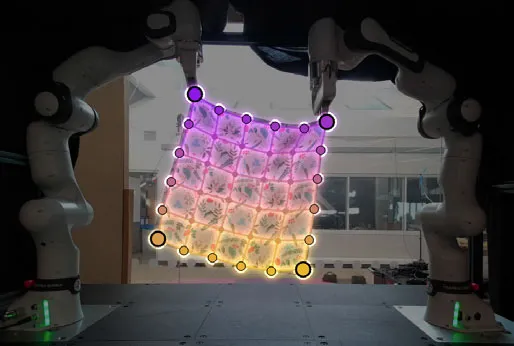
TrackDeform3D: Markerless and Autonomous 3D Keypoint Tracking and Dataset Collection for Deformable Objects
Yeheng ZongYizhou ChenAlexander BowlerChia-Tung Yang Ram Vasudevan
How can robots learn how deformable objects move when capturing 3D data on objects that bend, fold, and stretch typically requires labor-intensive annotation or expensive motion capture setups? TrackDeform3D, from the lab of Ram Vasudevan, professor of robotics, is an affordable and autonomous framework for collecting 3D datasets of deformable objects using only RGB-D cameras. The method identifies 3D keypoints and robustly tracks their trajectories, incorporating motion consistency constraints to produce temporally smooth and geometrically coherent data, and it outperforms state-of-the-art tracking methods in both geometric and tracking accuracy. Using the framework, the team built a high-quality, large-scale dataset covering six deformable objects and totaling 110 minutes of trajectory data.
A prosthetic foot for uneven world
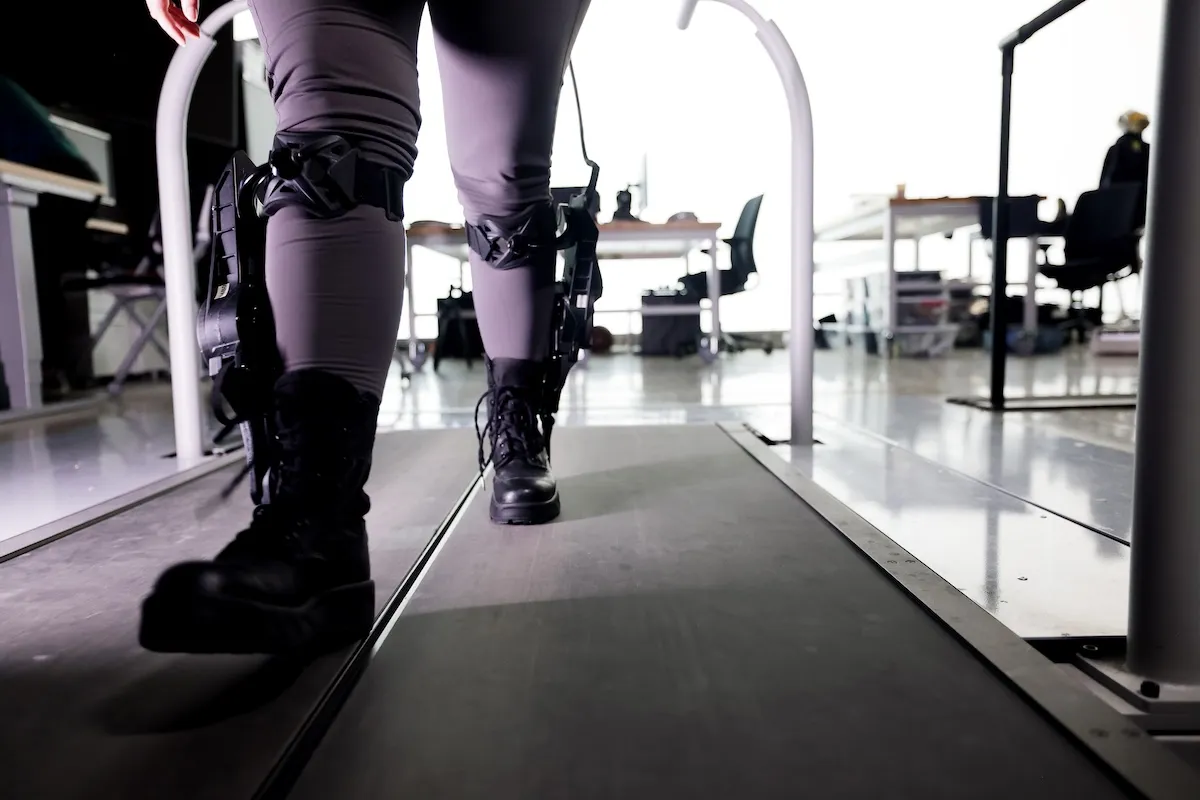
A Preliminary Study of the Effects of a Mechanically Adaptive Foot on a Powered Knee–Ankle Prosthesis Joint Mechanics on Uneven Terrain
Matteo CrottiElizabeth B. Wilson Manuel Giuseppe Catalano
 Elliott Rouse
Most powered prosthetic legs use a simple, non-adaptive foot, which is easy to build and control but can limit performance on uneven ground and around obstacles. This work from the lab of Elliott Rouse compares a powered prosthetic leg fitted with either a standard fiberglass foot or a mechanically adaptive one, testing both during walking with visible obstacles and on a treadmill with obstacle-like perturbations. The study suggests adaptability built into the foot itself can improve a prosthesis’s robustness without any changes to its higher-level control.
Compact circuit boards for wearable robots
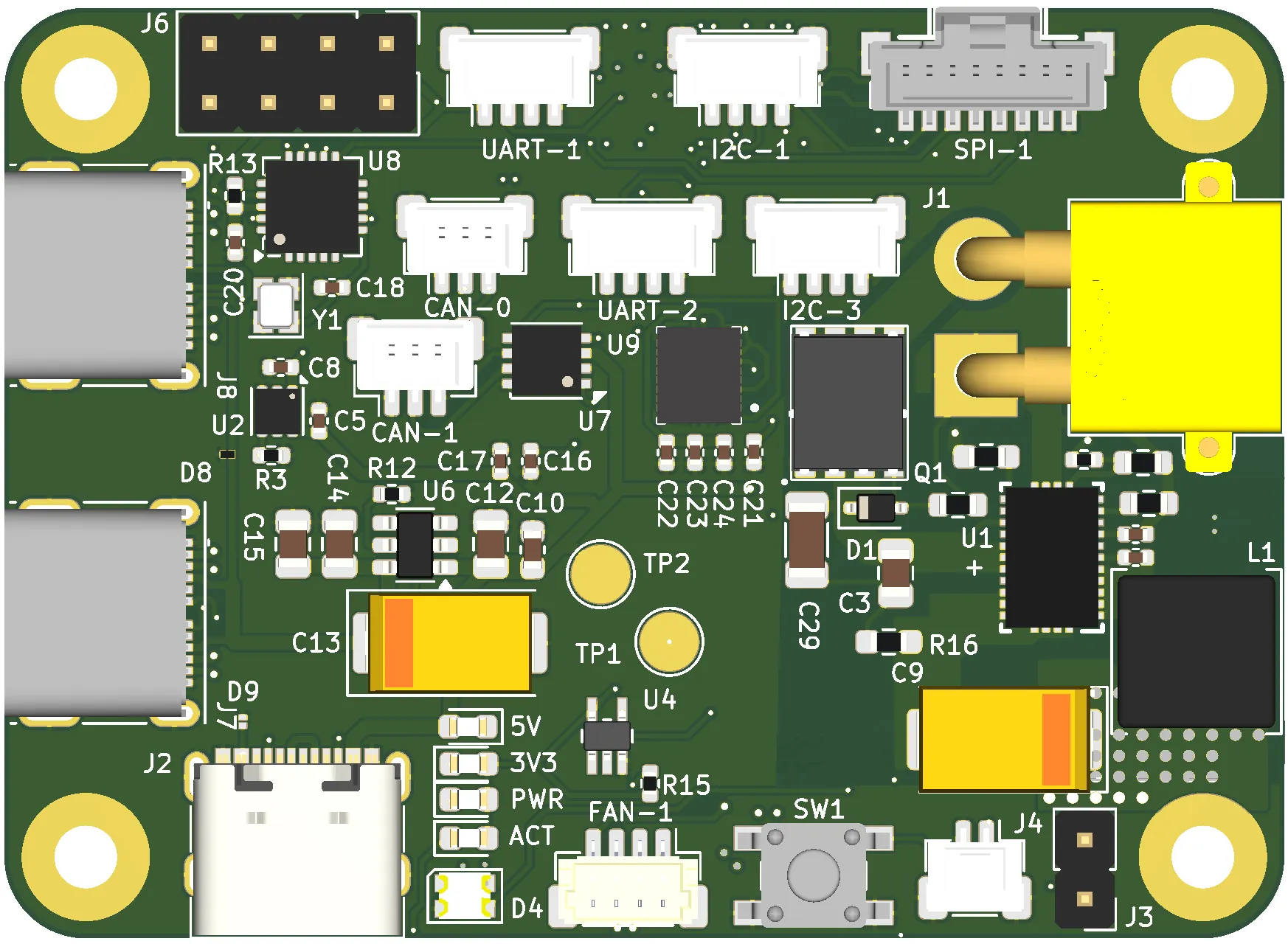
The CM Brushed Interface Board and Brushed Auxiliary Board: A Compact Modular System for Wearable Robotics
 Alan Murillo-SotoKa Hei NgEmily A. BywaterAnushka RathiJapmanjeet Singh GillJoshua LianElliott Rouse
Wearable robots need embedded electronics that are compact, robust, and computationally capable, but off-board hardware tethered to a waist pack limits real-world usability and rarely transfers between platforms. This work from Elliott Rouse’s Neurobionics Lab, accepted as a Late Breaking Results poster at IROS 2026, presents a modular embedded system built around a Raspberry Pi Compute Module and two custom circuit boards. The CM Brushed Interface Board packs a motor driver, quadrature encoder counter, inertial measurement unit, 16-bit analog-to-digital converter, and power management into a small footprint, while an optional Brushed Auxiliary Board stacks on top to add a second motor driver and encoder counter, an SD card reader, and a barometric pressure sensor. Developed for the lab’s Variable Stiffness Orthosis, the stack co-locates all electronics in a package that can be mounted directly on the body, and its open-source software development kit aims to lower the barrier to prototyping across mechanically distinct wearable robotic systems.

Fast simulation makes soft robots quick studies
Rapidly Learning Soft Robot Control via Implicit Time-Stepping
Andrew ChoiDezhong TongXiaonan HuangSoft robots are notoriously slow to train in simulation because their contact-heavy dynamics bog down conventional simulators. This work from the lab of Xiaonan Huang, assistant professor of robotics, shows that fully implicit time-stepping in the DisMech soft-body simulator, paired with a new delta natural curvature control scheme, enables reinforcement learning policies to train up to 6 times faster in non-contact scenarios and 40 times faster in contact-rich ones compared to prior simulators, without sacrificing accuracy.
Giving tensegrity robots a sense of touch
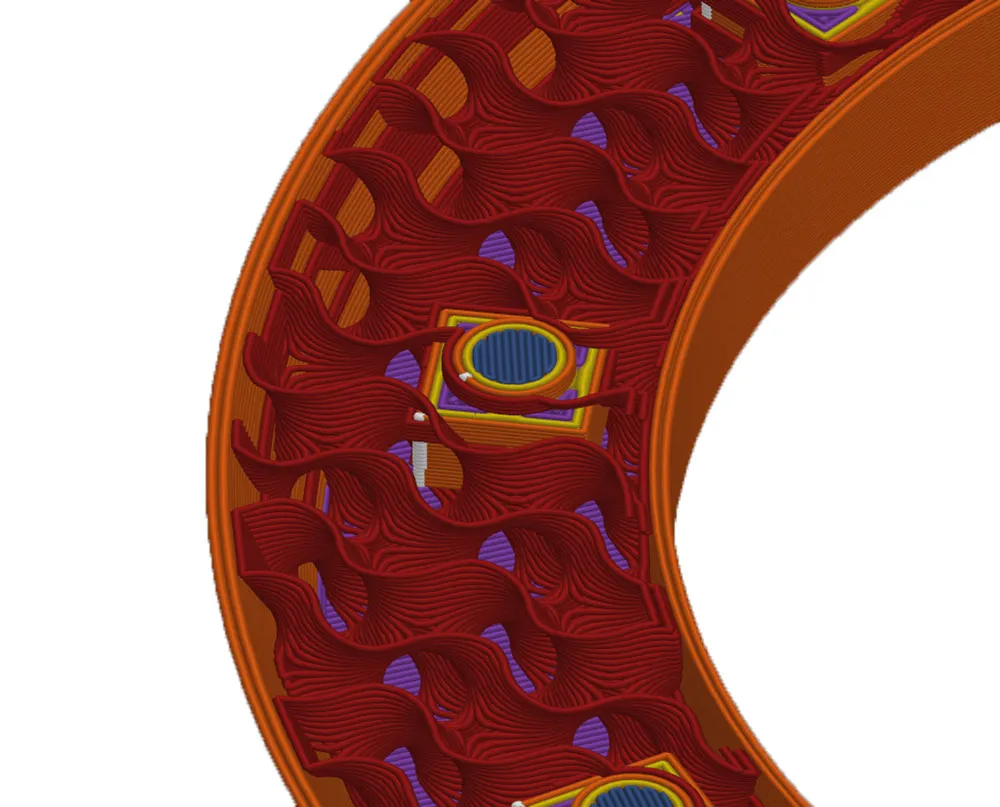
Scalable Open-Source Visuotactile Sensor for 6-Axis Contact Wrench Estimation in Tensegrity Robots
Wenzhe TongJonathan MiXili Yi Nima FazeliXiaonan Huang
Tensegrity robots, built from rigid struts held together by tension cables, can roll and tumble through rough terrain, but they have had no good way to feel what they touch. This collaboration between the labs of Xiaonan Huang and Nima Fazeli, associate professor of robotics, packs a camera, LED ring, and elastomer shell into each endcap of the robot, then uses a neural network to translate how the shell deforms into full six-axis force and torque measurements. Tested on a 12-kilogram robot, the sensor reliably detects ground contact, and a novel 3D-printed bonding technique keeps the whole design durable, lightweight, modular, and open source.
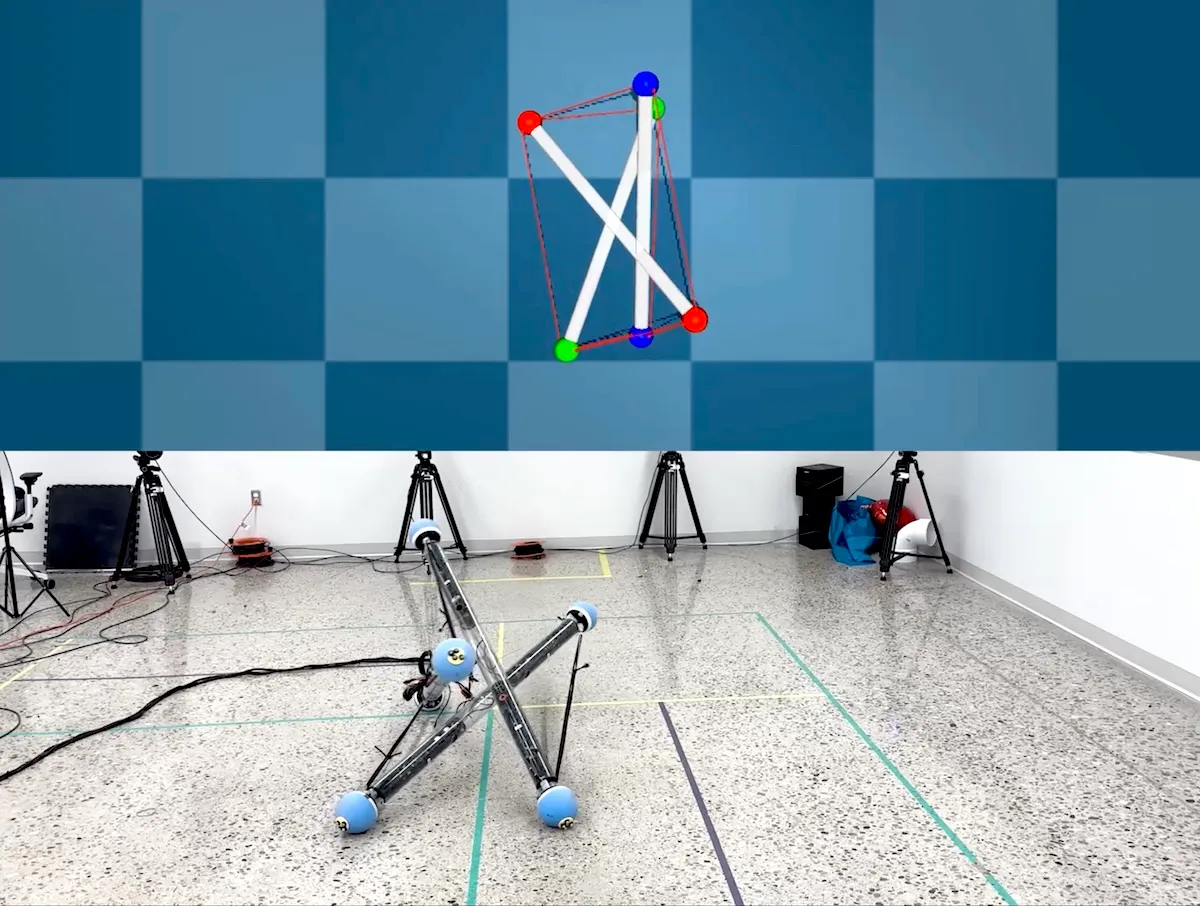
Learning to move from the robot's own structure
Morphology-Aware Graph Reinforcement Learning for Tensegrity Robot Locomotion
Chi ZhangMingrui LiWenzhe TongXiaonan HuangHow should a robot with no legs, spine, or wheels learn to move? By understanding its own body plan. This work, from Xiaonan Huang’s lab and published in IEEE Robotics and Automation Letters, represents a tensegrity robot’s physical topology as a graph and feeds it to a graph neural network policy, which learns coupling among the robot’s struts and cables for faster, more stable training than standard approaches. Policies learned in simulation transferred directly to a physical three-bar tensegrity robot without fine-tuning, achieving stable straight-line tracking and turning in the real world.

A reflex for catching dropped objects
CADRE: Dynamic Catching via Implicit Contact Descriptors and Task-Appropriate Recovery Affordances
Fan YangZixuan Huang Abhinav KumarSergio Aguilera MarinovicSoshi IbaRana Soltani ZarrinDmitry Berenson
When a robot hand fumbles an object, the difference between a minor stumble and a catastrophic failure is whether it can catch the object and get back to work. CADRE, from Dmitry Berenson’s lab and collaborators, is a reinforcement learning framework that catches a falling object while it is still within grasping range, then resets the hand to a configuration ready to resume the original task. By reasoning about finger-object contact through implicit neural descriptors rather than object pose alone, CADRE trains more efficiently, recovers more successfully, and generalizes zero-shot to objects it has never seen.
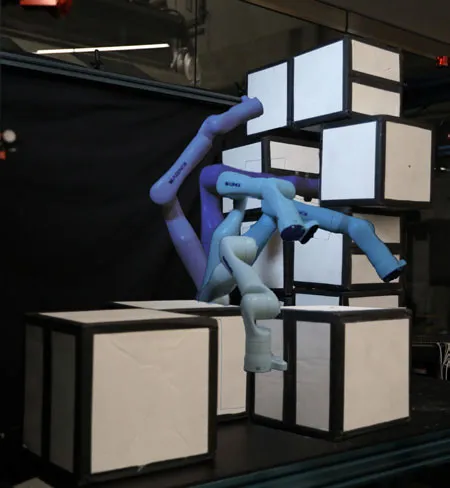
Faster motion planning for any cost function
Phasing Through the Flames: Rapid Motion Planning with the AGHF PDE for Arbitrary Objective Functions and Constraints
 Challen Enninful AduCésar E. Ramos ChuquiureYutong ZhouPearl LinRuikai YangBohao ZhangShubham SinghRam Vasudevan
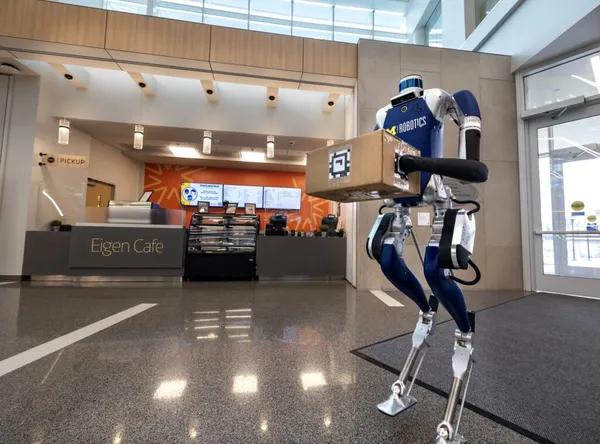
Generating a smooth, dynamically feasible trajectory for a complex robot in seconds is hard enough when minimizing a single cost function, and real tasks call for all kinds of cost functions and constraints. This work from Ram Vasudevan’s lab extends the Affine Geometric Heat Flow (AGHF) PDE, previously limited to a single cost type and initial guesses that already satisfied constraints, to handle arbitrary objective functions. A new two-phase algorithm lets planning start from constraint-violating initial guesses while still guaranteeing convergence, tested across multiple robotic systems including the Digit humanoid.
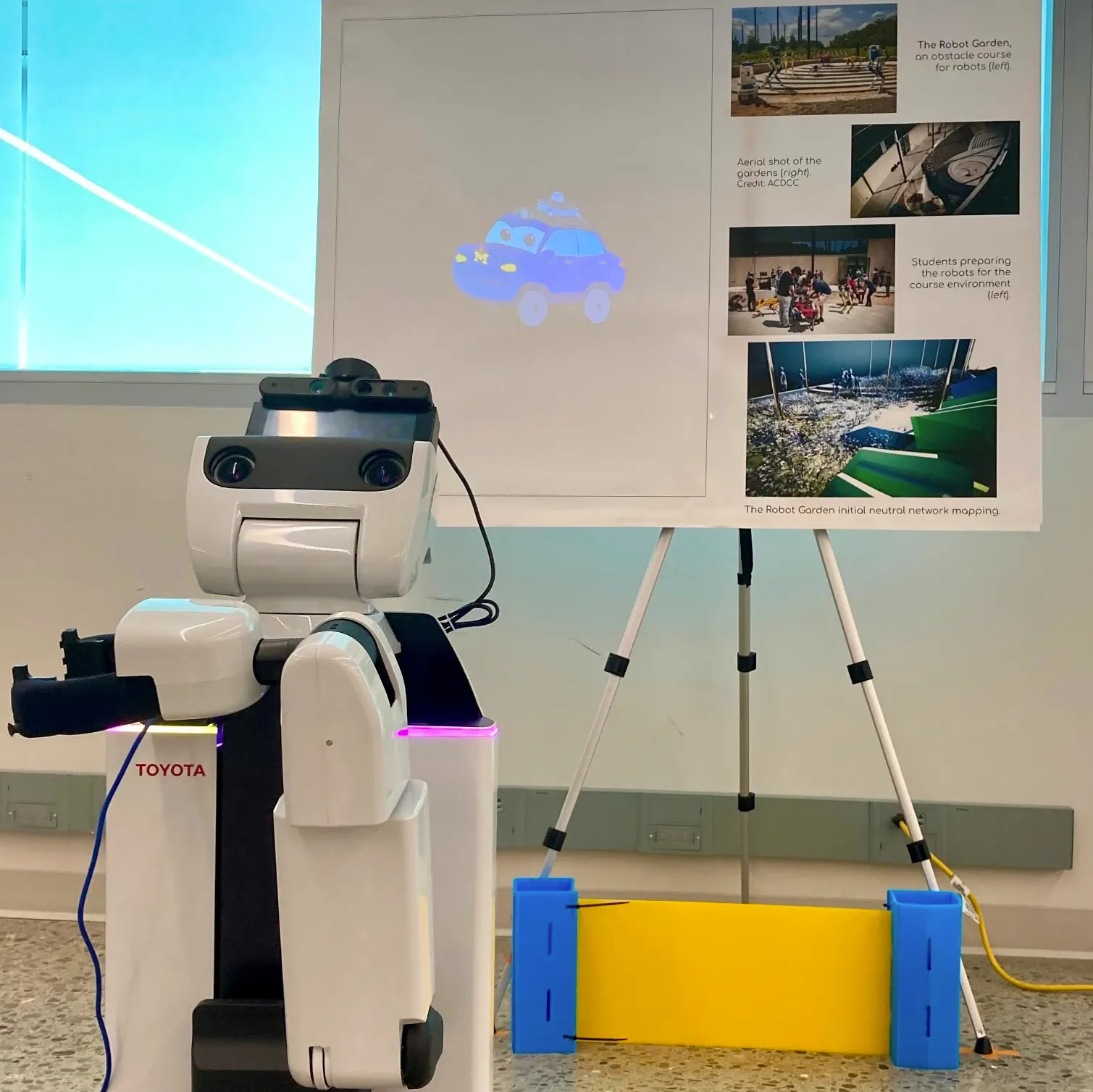
A dual-agent museum tour guide
Mixed-Agent Museum Tour Guide Design Improves Gendered Learning Outcomes and Visitor Preferences
Annette M. MastersonWonse JoHelena C. Sieh Lionel P. Robert Jr.
 Dawn Tilbury
Museums increasingly use robots to entertain and educate visitors, but a single physical robot can only be in one place, playing one role, at a time. This work from the labs of Lionel P. Robert Jr. and Dawn Tilbury pairs a physical tour-guide robot with a projected virtual agent that converses and interacts alongside it, giving visitors the richness of two guides from a single platform. In a study with 30 participants, engagement and overall quality of experience held steady across conditions. Participants said in interviews that they preferred the mixed-agent team.
More papers with Michigan authors at IROS 2026
- Execution-Level Trajectory Optimization for Repetitive Robotic Tasks Using Iterative Learning Control
Tong Chen, Dawn Tilbury, Kira Barton · At IROS ↗ - Model Predictive Control of Tensegrity Robots via Contact-Aware Graph Neural Dynamics Model
Nelson Chen, Patrick Meng, Charles Tang, Angelina Degay, Zachary Brei, Rebecca Kramer-Bottiglio, Kostas E. Bekris, Mridul Aanjaneya · At IROS ↗ - Stereo4DWalker: Learning 4D-Aware Embodied Urban Navigation from Internet Stereo Videos
Wentao Zhou, Xuweiyi Chen, Vignesh Rajagopal, Jeffrey Chen, Rohan Chandra, Zezhou Cheng · At IROS ↗ - GraphMap: Scalable Crowd-Sourced Global Vectorized HD Map Construction via Sparse Visual Graph Fusion
Ruiyang Zhu, Minkyoung Cho, Shuqing Zeng, Fan Bai, Morley Mao · At IROS ↗ - RIX: A Minimal POSIX-Compliant Robot Operating System for Portable Robotics Education
Broderick Riopelle, Matthew Greenbaum, Mahmood Wajahat, Doss Winston, Darren Cleeman, Odest Chadwicke Jenkins · At IROS ↗ - Deep Reinforcement-Learning-Guided Model Predictive Control for Preventing Overtakes in Autonomous Racing
Yufei Xi, Yijie Liao, Tulga Ersal · At IROS ↗ - Super LiDAR Intensity for Robotic Perception
Wei Gao, Jie Zhang, Mingle Zhao, Zhiyuan Zhang, Shu Kong, Maani Ghaffari, Dezhen Song, Chengzhong Xu, Hui Kong · At IROS ↗ - Object Reconstruction under Occlusion with Generative Priors and Contact-Induced Constraints
Minghan Zhu, Zhiyi Wang, Qihang Sun, Maani Ghaffari, Michael Posa · At IROS ↗ - REST: Receding Horizon Explorative Steiner Tree for Zero-Shot Object-Goal Navigation
Shuqi Xiao, Maani Ghaffari, Chengzhong Xu, Hui Kong · At IROS ↗ - AirSplan: Risk-Aware Motion Planning for Quadrotors in Cluttered 3D Gaussian Splats
Seth Isaacson, William Hong, Katherine Skinner, Ram Vasudevan · At IROS ↗ - Data-Efficient Real-Time Control of an Artificial-Muscle-Driven Continuum Robot with Physics-Informed Koopman Operator
Jiahe Wang, Eron Ristich, Eric Weissman, Yi Ren, Jiefeng Sun · At IROS ↗ - Slot-Level Robotic Placement via Visual Imitation of One Human Video
Dandan Shan, Kaichun Mo, Wei Yang, Yu-Wei Chao, David Fouhey, Dieter Fox, Arsalan Mousavian · At IROS ↗ - RoEL: Robust Event-Based 3D Line Reconstruction
Gwangtak Bae, Jaeho Shin, Seunggu Kang, Junho Kim, Ayoung Kim, Young Min Kim · At IROS ↗ - Hierarchical Planning for the Cuboid Multi-Agent Collective Construction (Cuboid-MACC) Problem
Junil Min, Shambhavi Singh, Geordan Gutow, Smrithi Lokesh Seramalanna, Bhaskar Vundurthy, Jinwoo Choi, Howie Choset · At IROS ↗ - NavTrust: Benchmarking Trustworthiness for Embodied Navigation
Huaide Jiang, Yash Chaudhary, Yuping Wang, Zehao Wang, Raghav Sharma, Manan Mehta, Yang Zhou, Lichao Sun, Zhiwen Fan, Zhengzhong Tu, Jiachen Li · At IROS ↗ - Inverse Resistive Force Theory (I-RFT): Estimating Granular Terrain Mechanics from Robot–Terrain Interactions
Shipeng Liu, Feng Xue, Yifeng Zhang, Tarunika Ponnusamy, Feifei Qian · At IROS ↗ - Behaviour-Aware Adaptive Path Planning with Q-Learning Weight Adaptation
Jichao Zhang, Meiyi Yang · At IROS ↗ - Vision-Conditioned Variational Bayesian Last Layer Dynamics Models
Paul Brunzema, Thomas Lew, Ray Zhang, Takeru Shirasawa, John Subosits, Marcus Greiff · At IROS ↗
If you are making the trip, make sure to check out the above workshops and papers, as well as Pittsburgh recommendations. Please also see the IROS website for registration and visitor resources.